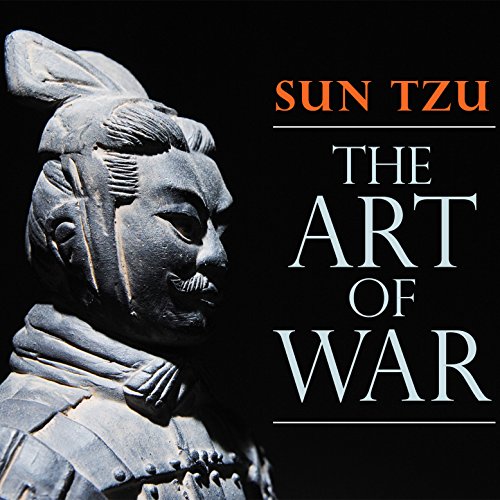
Sun Tzu once said: “If you know the enemy and know yourself, you need not fear the result of a hundred battles.” He wrote it down in his book, The Art of War. Sun Tzu is a man not capable of defeat! A man who prefers no conflict over conflict, yet, wrote a book with the capacity to not only face, but also instigate conflict. A military genius!
Somewhere in 544 BC, during the warring states period. In the ancient land of China, characterized by profound warfare between states and kingdoms alike, a time where the land is subdivided into 15 different states. During this time, in the state of Wu (Or Qi according to critics) a military master was born under the name of Sun Tzu, who would come to serve the state of Wu 30 years later and become one of the world’s best generals in history.
Best is to avoid conflict. Even Sun Tzu acknowledges this. Sun Tzu also acknowledges that conflict is unavoidable and is in fact, something that should be carried out under the strictest conditions. In order to ensure security, one must maintain control and only by deep knowledge of principle someone can change disturbance into order. In other words, In order to achieve peace, we need to be ready for war “Weapons are inauspicious instruments, not the tools of the enlightened. When there is no choice but to use them, it is best to be calm and free from greed, and not celebrate victory. Those who celebrate victory are bloodthirsty, and the bloodthirsty cannot have their way with the world” ~Sun Tzu, The Art of War
Sun Tzu was a renowned Chinese military general, writer and author of the infamous book called: “The Art of War”, written during the Zhou Dynasty (722-481 BCE). When he was serving under King Ho-lu, king of the Wu state as a general and strategist. In his nearly 40 years as a general he never, not once, lost a battle. His legacy serving as a foundation on military strategy for century’s ahead.
Want to read the Art of War yourself? Go here to read a shortened and free version for yourself
“There is no instance of a nation benefitting from prolonged warfare.” ~Sun Tzu. Sun Tzu see’s strength in overcoming armies without fighting. Not by fighting. “Therefor those who win every battle are not really skillful-Those who render others’ armies helpless without fighting are the best of all”
“The Art of War” serves not only as a guide but also as a means to war. It has assisted China and various other countries in their own battles and sieges. Such as the samurais from feudal Japan (1185-1603 AD) who studied his book and adopted its wisdom into their own philosophy and culture as Japanese warriors. Even in our lifetime, the Art of War is studied by plenty of academia and universities due to its cultural significance and strategic insights. It’s by far the best book ever written on warfare.
Based on the principles of the Tao Te Ching, a classic Chinese text on the foundation of Taoism, Sun Tsu wrote the Art of War. With most of its tactics and strategy following similar patterns. For example, Sun Tzu once said: “To overcome others’ armies without fighting is the best of skills” which emphasizes the Taoist way of avoiding conflict. Avoiding conflict is altogether considered one of the best things to do according to The Art of War. One could rename the Art of War to “The Art of Peace”.
Sun Tzu once had the honor of assisting He Lung, King of Wu. One day, he was brought into the palace. He Lung expressed his admiration towards the Art of War. He asked if Sun Tzu could test his theory about managing soldiers onto his concubines. To which Sun Tzu complied. 180 female concubines gathered outside the palace. Ready to begin the test.
The Art of War is subdivided into several chapters, all dedicated to the 13 elements of war.
- Strategic Assessments
- Doing battle
- Planning a Siege
- Formation
- Force
- Emptiness and Fullness
- Armed Struggle
- Adaptations
- Maneuvering armies
- Terrain
- Nine Grounds
- Fire Attack
- On the Use of Spies
It’s these 13 elements that assisted Sun Tzu in not only creating The Art of War, but also in his life as a general and militarist.
When 180 concubines gathered for the test conducted by Sun Tzu, they got divided into 2 companies. He placed 1 of the king’s favorite concubines at the head of each. “I presume you know the difference between front and back, right hand and left hand?” The girls said yes. “When I say “Eyes front,” you must look straight ahead. When I say “Left turn,” you must face towards your left hand. When I say “Right turn,” you must face towards your right hand. When I say “About turn,” you must face right round towards your back.” Once explained, the test begun. With weapons and instruments handed out Sun Tzu gave command. But when Sun Tzu ordered the concubines, they burst out in laughter. In response Sun Tzu said: “If words of command are not clear and distinct, if orders are not thoroughly understood, then the general is to blame.” Again, Sun tzu commanded the concubines, having now explained this principle of his teachings. Again, the concubines burst into laughter…
Sun Tzu is a great strategist, that much is known, it’s known that his work is derived from Taoist belief and that his work holds significance to military experts everywhere. One could however, question the efficiency and trustworthiness of his work. But history shows accuracy from the tales written in the Art of War. In the Art of War, chapter 7 (Armed Struggle) Sun Tzu wrote: “A surrounded army bust be given a way out” The purpose behind this is that when people are left but with no choice but to fight, they will give their all. If the enemy beliefs they can escape, they will choose to flee, leaving them vulnerable.
In the Battle of Mohi (11th April 1241 AD), during the reign of Genghis Khan, ruler of the Mongol Empire. The enemy tried to escape the Mongols after a overwhelming defeat in battle. What they did not know is that the Mongols had left them with a way out, purposely leading them into a trap. The opposing forces, keen and focused on escaping had not anticipated an ambush. By using methods described in The Art of War the Mongol empire stood victorious that day. They provided the enemy a way out, and used this to their advantage. The Art of War goes more in depth on the specifics and the philosophy behind these strategies and tactics.
If words of command are not clear and distinct, if orders are not thoroughly understood, the general is to blame. But if his orders ARE clear, and the soldiers nevertheless disobey, then it is the fault of their officers.” And thus, Sun Tzu ordered the two favorite concubines of the king, head of the two companies, to be beheaded. The king, alarmed that his two favorite concubines where about to be beheaded hurriedly said: “We are now quite satisfied as to our general’s ability to handle troops. If We are bereft of these two concubines, our meat and drink will lose their savor. It is our wish that they shall not be beheaded.” However, Sun Tzu rejected this and said: “Having once received His Majesty’s commission to be the general of his forces, there are certain commands of His Majesty which, acting in that capacity, I am unable to accept.” And thus the two female concubines were beheaded and their spots had been taken by 2 newly assigned heads. Once again, Sun Tzu conducted his test. He commanded the concubines once again. However this time, the concubines succeeded without error.
After the test, Sun Tzu said to the King: “Your soldiers, Sire, are now properly drilled and disciplined, and ready for your majesty’s inspection. They can be put to any use that their sovereign may desire; bid them go through fire and water, and they will not disobey.”
The Art of War was the main way as to which Sun Tzu battled for his nation, Like the Battle of Boju (506 BC). Sun tzu managed to lead his army to gain a decisive victory in this battle using tactics written in his work. They were able to capture the capital of rival kingdom Ying and conclude their success. It’s true that Sun Tzu is a great man and a great strategist.
It’s these stories that make Sun Tzu renowned as a military genius, The Art of war is considered a manual on warfare and for good reason. Some critical believers think Sun Tzu died somewhere during 496 BC alongside his king in battle. However, the Wu state still had many victories and achievements even after this alleged dead. And as stated in the art of war: “Be extremely subtle, even to the point of formlessness. Be extremely mysterious, even to the point of soundlessness. Thereby you can be the director of the opponent’s fate.” It could be possible Sun Tzu died and concealed his identity in order to assist his nation in secrecy. If that is true, it truly shows the legacy and greatness of his teachings.
 MelvinV